
The making of my Seahorse lino print.
In this post I share with you how I created this Seahorse lino print.
When I tried lino cutting for the Artful video, I used small Essdee softcut blocks as test pieces and carved a little seahorse. I accidentally forgot to add the fin to it though. So, I decided to create a bigger seahorse – this time with a fin.

For this Essdee softcut block, I only used my Essdee and Abig carving tools. After drawing the seahorse I traced it onto transfer page, placed the back of the paper with the pencil lead on the block and went over the lines to transfer it. The most difficult bit when cutting the block was actually cutting the round shapes. They are not quite as round as I wanted them.


Originally, I was thinking to print in black and red and tested this with the water-based ink, that came with the Artful box. This was however difficult to do as it’s just one block. In the future I might try my hand at reduction block or multiple block printing. But for the time being I am sticking to one colour.
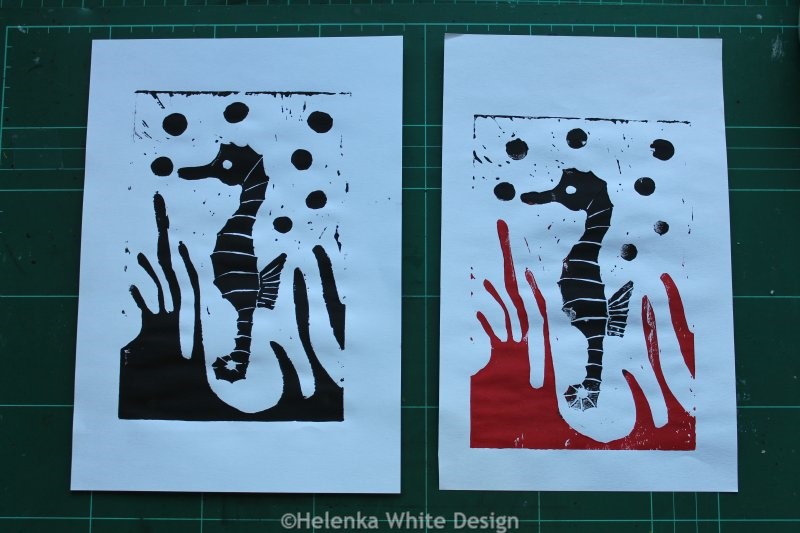
When I tried to print the edition of this seahorse, I originally used Fabriano Unica paper (which is better suited for a press rather than for hand-printing) and water-based ink. This proved to be rather difficult and frustrating as the prints didn’t come out very well. It took a lot of practice! All those “wasted” sheets of paper are now being used for other art projects, as I don’t like wasting things. For my final edition I used the Caligo Safewash ink, which is oil based and doesn’t dry on the surface I roll out the ink on – a problem you get with water-based ink, which dries quickly. As a registration method for this print, I used my DIY guides.

I ended up with 12 prints I was happy with. I could have made more, but by that time I got a bit fed up and decided to stop there.
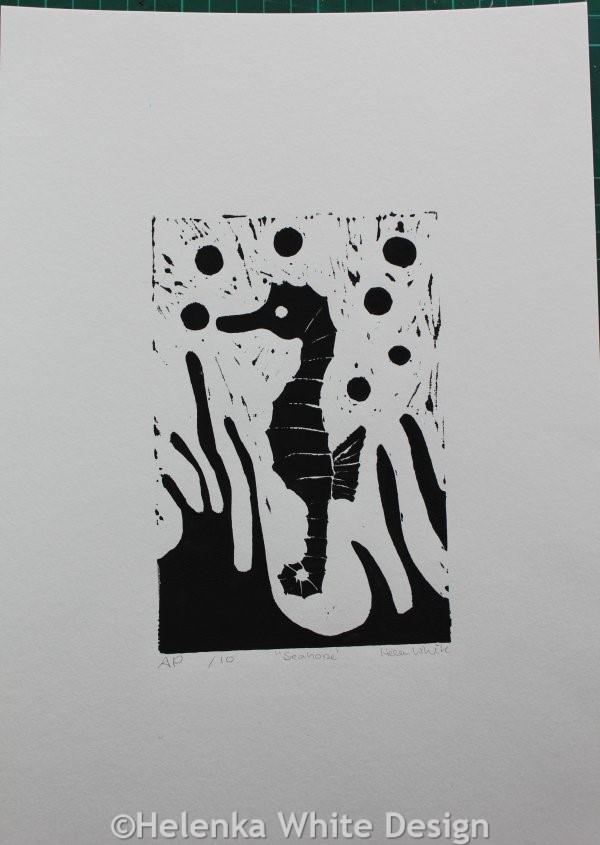

I hope you like the seahorse. You can find the prints here.
Thank you for reading.
Helen x